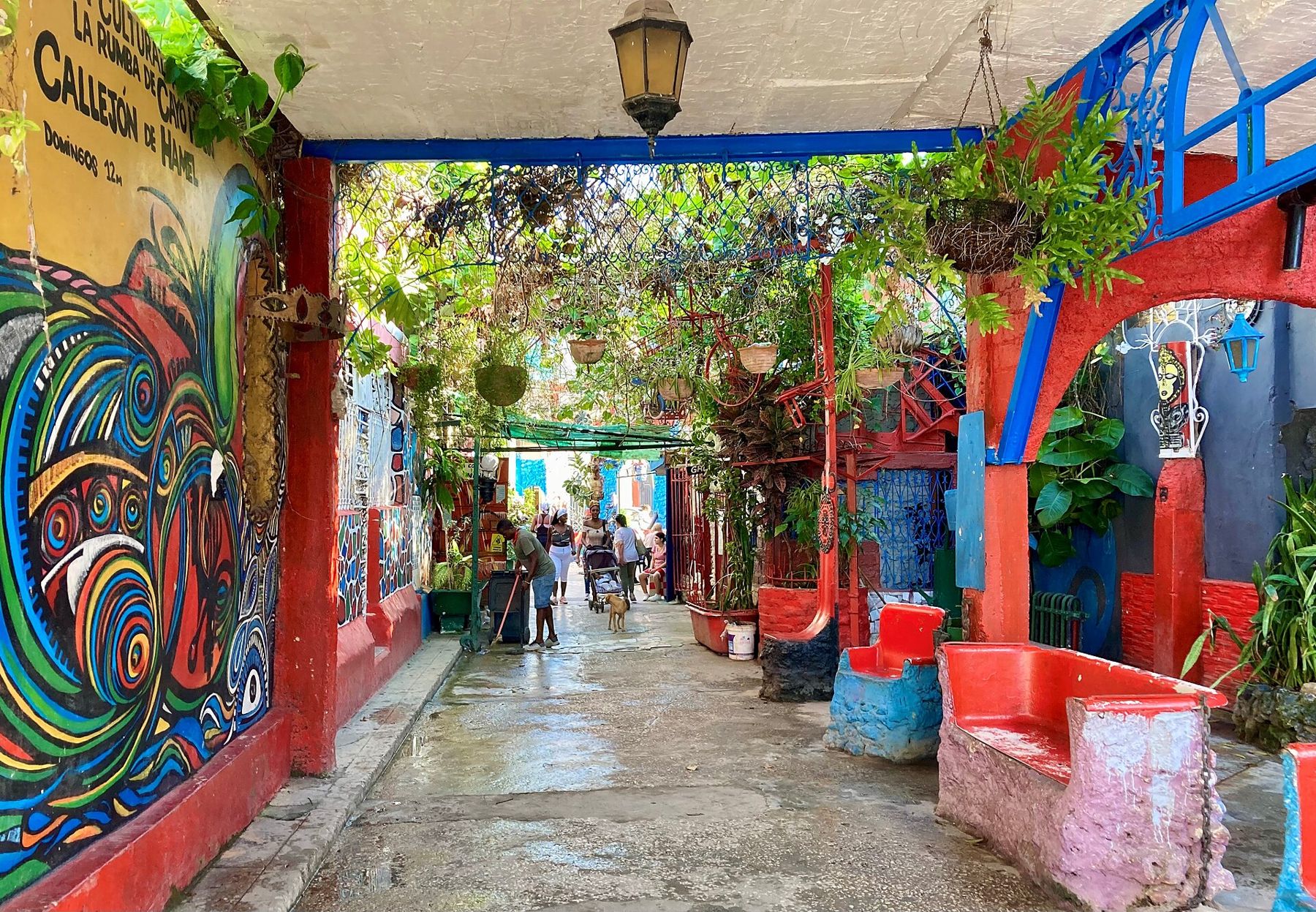
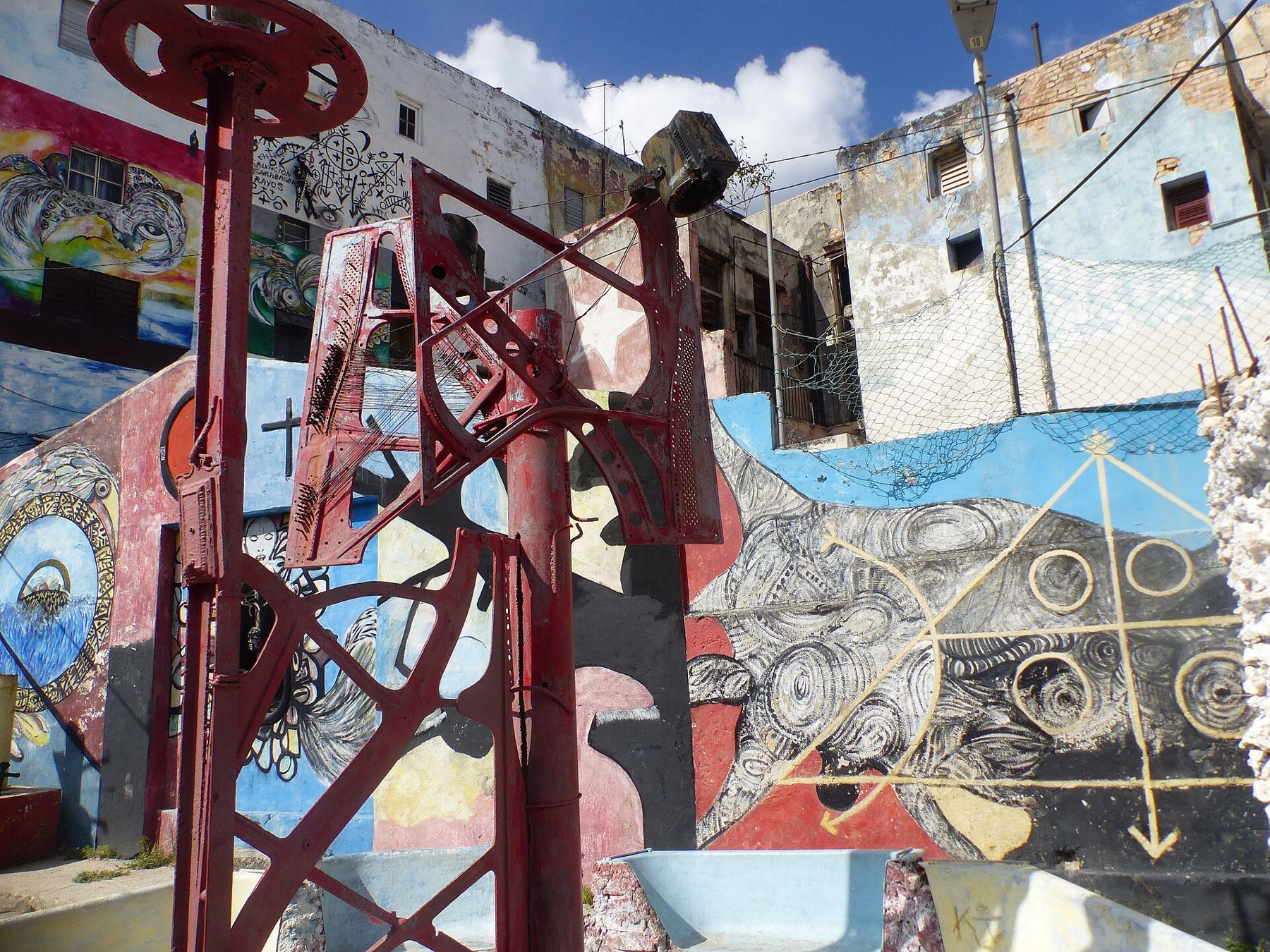
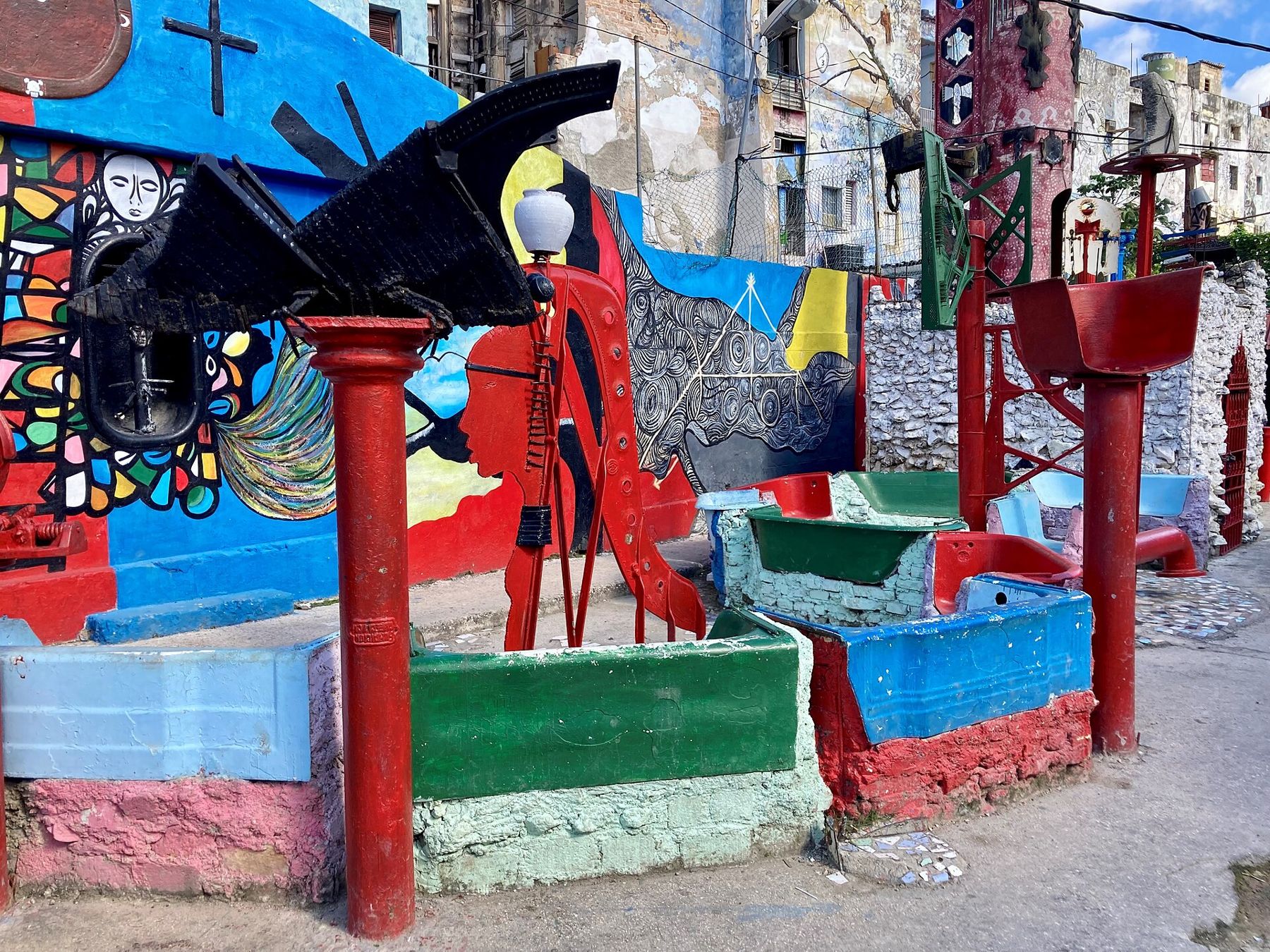
The Callejón de Hamel is barely a block long, a narrow alley in the Cayo Hueso corner of Centro Habana, a few streets up from the sea wall. Most days it is a quiet open-air gallery: walls painted in loud reds, blues and yellows, sculptures welded from scrap iron, old bathtubs turned into benches, and symbols drawn in chalk-white lines that belong to Afro-Cuban religion. On Sunday, around midday, it becomes something else. Drummers set up, a crowd presses in from both ends, and for a couple of hours the alley carries one of the most direct versions of Cuban rumba you can hear in the capital.
What rumba is, and where it came from
Rumba is not the ballroom dance that borrowed its name. In Cuba it means a family of drum, song and dance forms that grew up in the second half of the nineteenth century among Afro-Cuban workers in the port cities of Matanzas and Havana: on the docks, in the rail yards, and above all in the solares, the crowded tenement courtyards where many families shared one patio. People played on whatever was at hand. Packing crates and drawers became drums, which is why you still hear the phrase rumba de cajón, rumba of the box. The music mixes rhythms that came from West and Central Africa with Spanish-derived ways of singing and rhyming, and it was for a long time looked down on by polite society. Today it is recognised as a central part of Cuban culture, and it has been on the UNESCO list of intangible cultural heritage since 2016.
If you want the longer story of the city that claims rumba's birth, the day trip to Matanzas, where rumba began, is the place to pick it up.
The three styles you may hear
Rumba is usually described in three main forms, and a Sunday session can move between them.
- Yambú is the slowest and oldest-feeling. A couple dances with gentle, sometimes playfully old-fashioned movements, and the mood is courtly rather than competitive.
- Guaguancó is the one you are most likely to see. A man and a woman dance a game of pursuit. At moments he makes a sudden gesture toward her, a hip thrust, a flick of a handkerchief or a foot, called the vacunao. She covers herself or turns away in time, and the crowd watches to see who has the wit and the timing.
- Columbia is fast, in a rolling six-beat feel, and is traditionally danced by men alone, one at a time, in a kind of acrobatic dialogue with the lead drummer. It is linked to the rural areas of Matanzas province.
Each piece usually opens with a solo singer improvising a long, free line, sometimes in nonsense syllables, before the song proper starts. Then comes the part where a lead voice calls and the chorus answers, the drums lift, and the dancers step in.
The instruments, by ear
Three conga drums, called tumbadoras in Cuba, carry the music. The lowest holds a steady pattern, the middle one plays an answering part that locks with it, and the highest, the quinto, is the lead drum. The quinto player improvises: listen for the quick, cracking phrases that seem to comment on the singer and, during guaguancó and columbia, on every move the dancers make. A good quinto player and a good dancer react to each other like two people finishing each other's sentences.
Underneath, someone strikes a wooden box or cylinder with two sticks, the guagua or catá, and someone plays claves, the two hardwood sticks that click out the five-stroke pattern every other part leans on. Rumba's version of that pattern is slightly different from the one in son, with one stroke pushed later, which gives it a more urgent pull. There is a whole story on learning to hear the two-three if you want to train your ear before Sunday.
 Flip it overSon, the sound under everythingPhoto: kuhnmi, CC BY 2.0
The alley itself
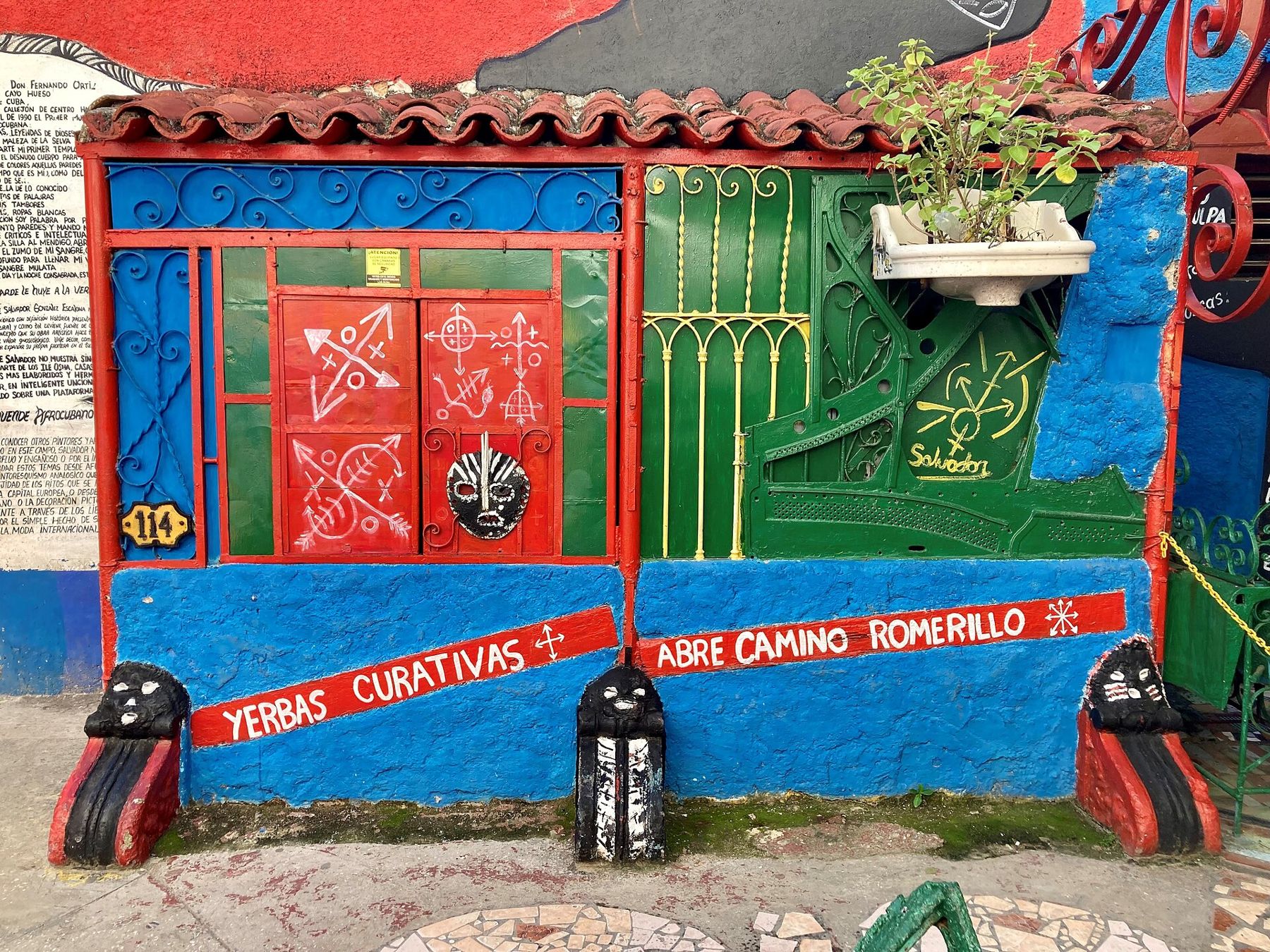
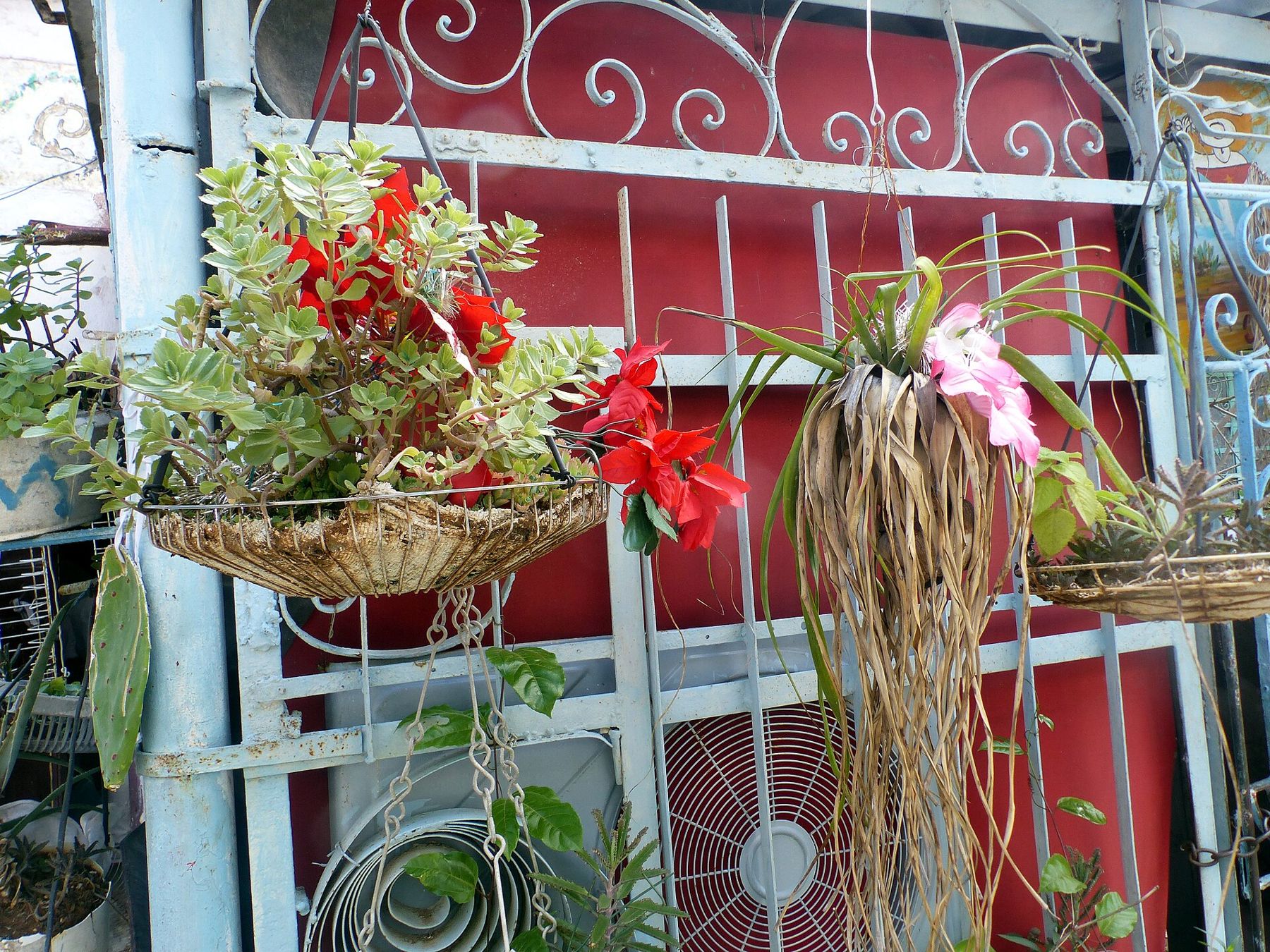
The murals began in 1990, when an artist who lived nearby started painting the walls, and neighbours and the local community turned it into a cultural project. The imagery draws heavily on Afro-Cuban religions. You will see references to the orishas of Regla de Ocha, often called Santería, and to Palo Monte, a Congo-derived tradition whose drawn signatures, called firmas, look like arrows, crosses and circles. Treat these as what they are: sacred signs for many people, not decoration. Small displays of herbs and plants used in religious practice are part of the alley's life too. For a careful introduction to the religious side of Cuban drumming, read batá drums and the sacred rhythms.
A good quinto player and a good dancer react to each other like two people finishing each other's sentences.
How to watch with respect
The Sunday rumba is a performance in the sense that people come to watch, but it grew out of a neighbourhood, and the best way to enjoy it is to act like a guest.
- Arrive early. The alley is narrow and fills quickly. If you want to see the dancers rather than the back of someone's head, get there well before the music starts.
- Keep the dance space open. When a circle forms, stay at its edge. Do not walk through it to get a better photo.
- Ask before photographing people up close. Wide shots of the crowd and the walls are one thing; a lens in a dancer's face is another.
- Dance only if invited. Guaguancó has rules and a flirtatious logic. If someone draws you in, follow their lead and keep it light.
- Expect to be asked for money. There may be an entry charge, a hat passed around, or people selling drinks, crafts and recordings. Bring small notes and decide in advance what feels fair.
- Watch your pockets. Like any packed crowd, it is a place to keep phones and wallets close.
Start times, whether a session happens at all on a given week, and any entry fee can change. Ask locally the day before and check before you go.
Getting there and staying on
The alley sits in Cayo Hueso, between the sea wall and the busy commercial streets of Centro Habana. The simplest way in is on foot: walk from the Malecón inland for a few blocks, or come from Vedado along the streets parallel to the sea. Taxi drivers know it by name. Afterwards, the surrounding blocks are worth a slow walk; the story on Centro Habana, block by block gives you a route.
If you only have one Sunday in Havana, this is a strong way to spend its middle. Take the rest of the afternoon slowly. Your ears will still be ringing with the quinto when you reach the sea.