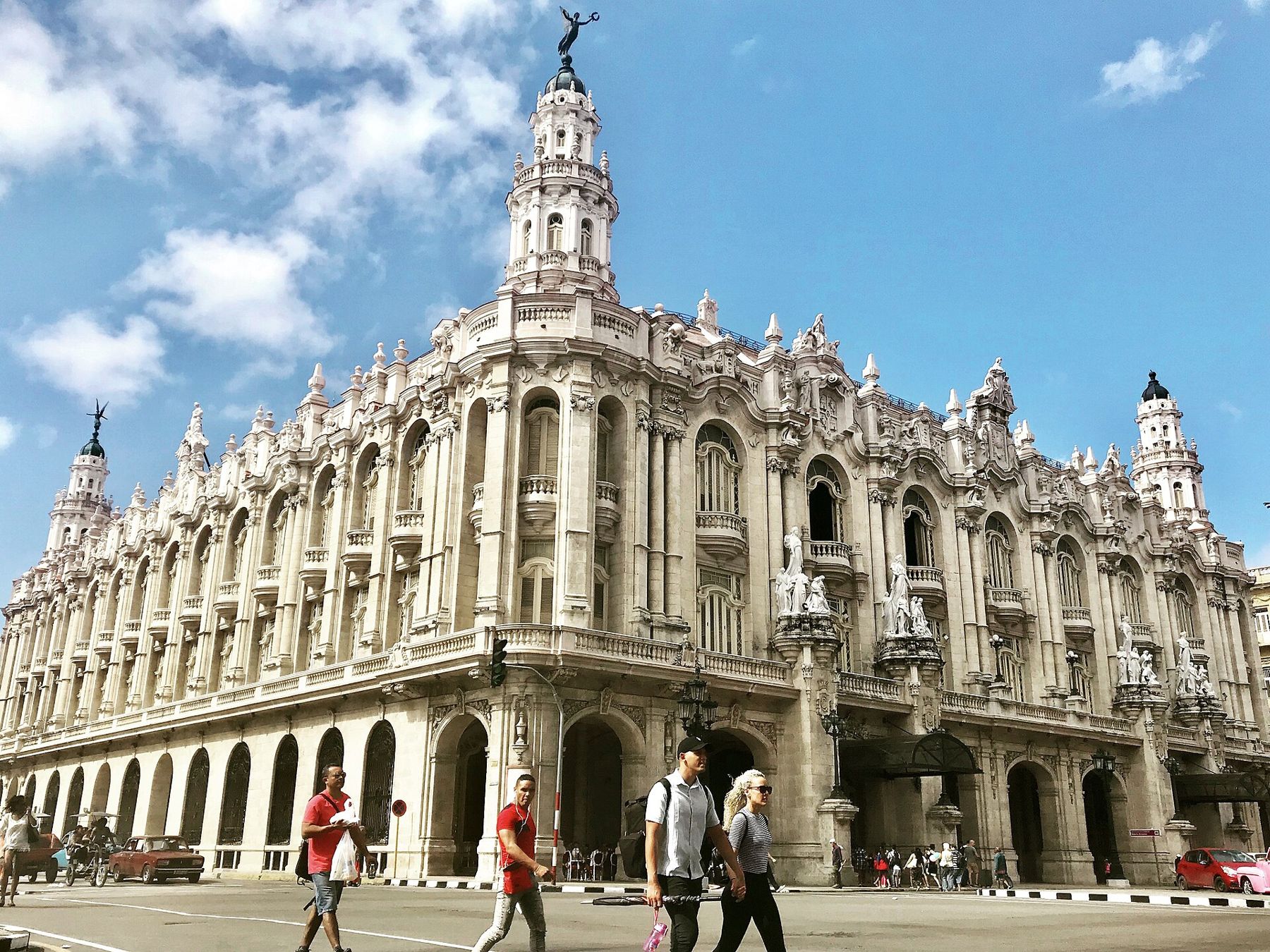
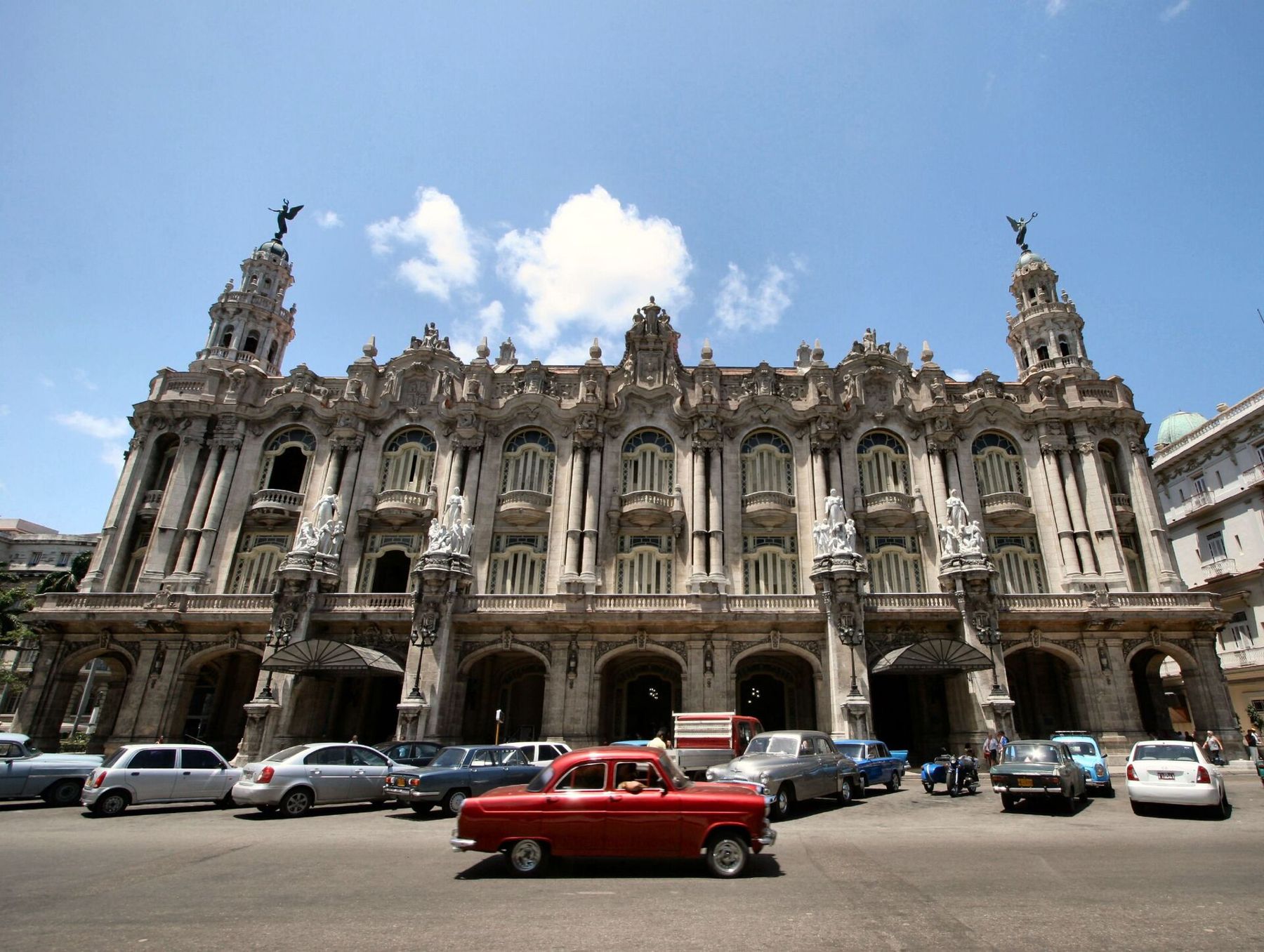
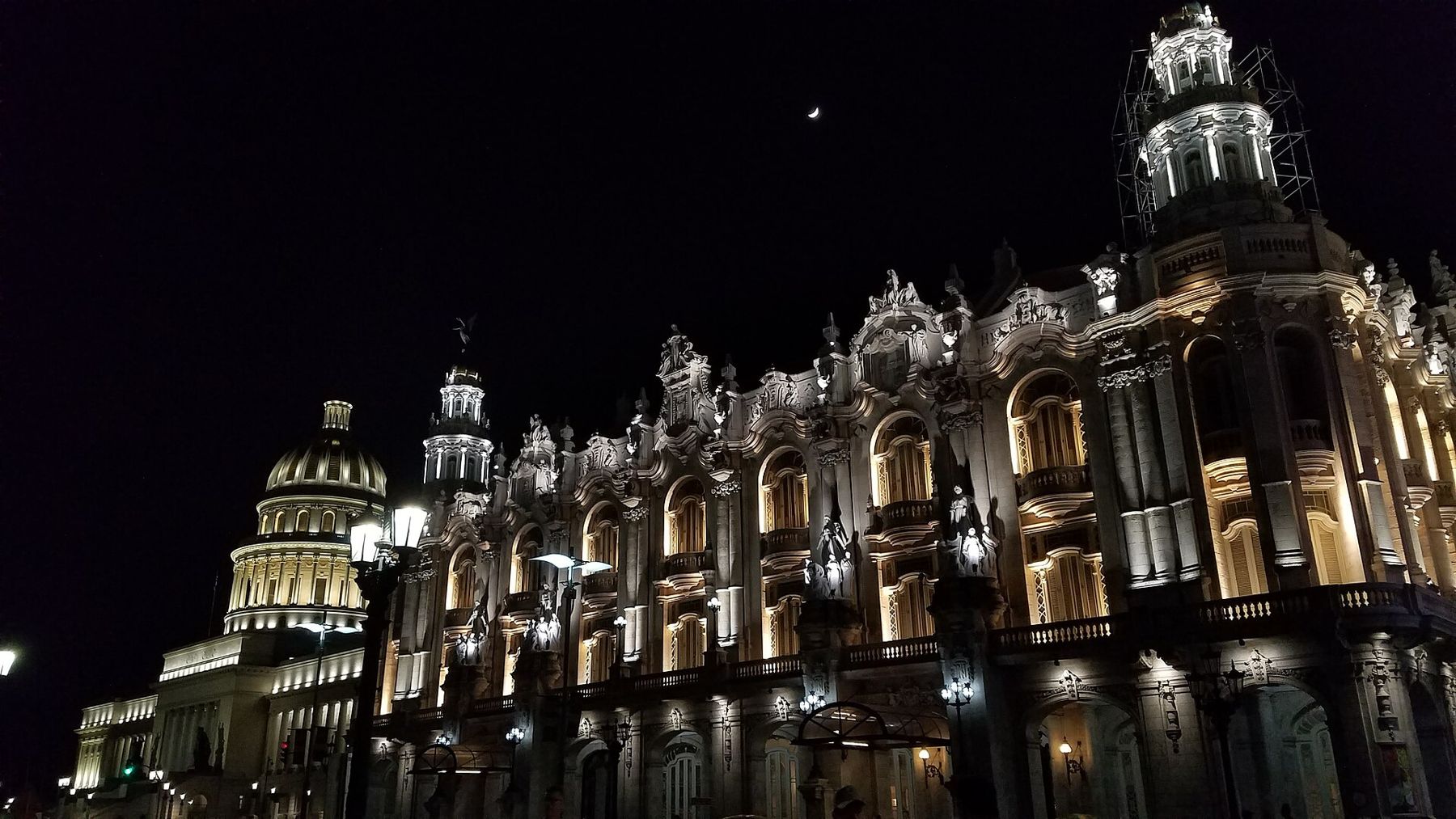
The Gran Teatro de La Habana stands on the Paseo del Prado, across from Parque Central and next to the domed Capitolio. It is one of the most elaborate buildings in the city: a wedding cake of white stone with corner towers, balconies and sculpture groups reaching out over the street. Inside is the main stage of Cuba's national ballet, and an evening there is one of the most rewarding things you can do in Havana, whether or not you think of yourself as a ballet person.
The building
The current palace was built in the early twentieth century for a Galician social club, one of the large mutual-aid societies formed by Spanish immigrants, and it opened in 1915. It was built around an older theatre on the same site that dates back to the 1830s, so there has been a stage here for close to two centuries. The style is often called neo-baroque: heavy cornices, carved figures and a riot of detail that rewards a slow look from across the street.
The building was restored in the 2010s and reopened with its stonework cleaned and its halls refreshed. It holds several performance spaces, the largest being the main hall with its tiers of boxes and balconies. It is also used for opera, concerts and other dance companies, so the programme varies through the year.
Next to it, the old cars lined up along Parque Central make a strong picture of their own; the story on the old American cars explains why they are still running.
Cuba and the ballet
Cuban ballet has its roots in the 1930s and 1940s, when a small group of Cuban dancers trained in Havana and abroad and returned to build a company. The national company was founded in 1948 and, from the 1960s, the state supported ballet training across the country through a network of schools. Havana's national ballet school is one of the largest in the world.
What came out of that system is often called the Cuban school of ballet. It is rooted in the classical Romantic repertoire, the great nineteenth-century story ballets, but with its own character. People who follow dance often point to a few things: clean, precise technique; long balances; quick, bright footwork; and male dancers with real power in their jumps and turns. Many Cuban-trained dancers have gone on to lead companies around the world, and the school is respected internationally.
Training is long and demanding. Children enter the ballet schools young, after auditions, and study dance alongside ordinary school subjects for years before a small number join a professional company. That pipeline is one reason the standard of the corps de ballet, the large group of dancers who perform together behind the soloists, is so even. When twenty dancers move as one in a classic white-skirted scene, you are seeing the result of that schooling.
The company's repertoire leans on the classics, with full-length productions of famous story ballets alongside newer Cuban work. Havana also hosts an international ballet festival in some years, usually in the autumn, which brings visiting companies and extra performances. Dates vary, so check before you go.
The hall's acoustics and its rings of seating make even a small recital feel like an occasion.
Seeing a performance
Performances by the national ballet are not every night, and seasons shift around tours and festivals. A few practical points:
- Check the programme in Havana. Ask at the box office in the building, or ask your host to check. Programmes are announced on a short timescale and can change.
- Tickets. Visitors usually pay a different price from Cuban residents. Payment methods change; carry some cash and check before you go.
- Where to sit. The stalls give you the full view of the stage. The upper balconies are steep but give you the whole sweep of the hall, which is a sight in itself.
- Dress. There is no strict code, but most of the audience dresses neatly. Long trousers or a dress, and no beachwear, is the safe choice.
- Arrive early. Give yourself time to look at the foyer and the staircases.
- Photography. Assume none during the performance.
If there is no ballet during your stay, a concert, opera or another company is still a fine reason to go in. The hall's acoustics and its rings of seating make even a small recital feel like an occasion. Some days the building has also offered guided tours; ask at the door.
 Flip it overJazz nights in VedadoPhoto: Tacorontey, CC BY-SA 4.0
What to listen for
A ballet evening is mostly about watching, but it has its own sounds. The orchestra tuning in the pit. The rustle and murmur as the lights go down. Pointe shoes landing, a soft knock against the stage floor that you only hear in the quietest moments. The audience in Havana is attentive and often knowledgeable. You will hear applause in the middle of a scene after a particularly brilliant solo or balance, which is normal in ballet, and you may hear people calling out approval to a favourite dancer.
The music is usually the standard orchestral score for the work being danced. If you know it, you will notice where the dancers phrase with it and where they stretch a moment for effect. If you do not, you will simply hear how closely the music and the movement work together.
The Paseo del Prado outside
When you come out, the Prado is right there. This broad promenade runs from Parque Central down to the sea, a raised walkway between two lanes of traffic, lined with laurel trees, stone benches and bronze lions. By day, children play there, people sit and talk, and on some weekends artists set up to sell their paintings. By night it is cooler, quieter, and lit by street lamps, a pleasant walk to the Malecón at dusk or after dark.
On one side of the Prado lies Centro Habana, dense and lived-in; on the other, the edge of the old town. The story on Centro Habana, block by block gives you a sense of the streets to one side, and the walk through the four plazas of Habana Vieja starts a few blocks away on the other.
Look up as you walk. The Prado's buildings are a catalogue of Havana's styles, from colonial arcades to early twentieth-century apartment blocks with ornate balconies and Art Deco details. Many have been repaired in recent years; others are still waiting. The iron street lamps, the stone benches and the long double line of trees give the walk a steady rhythm, and the noise of the city drops to a murmur in the middle of the promenade.
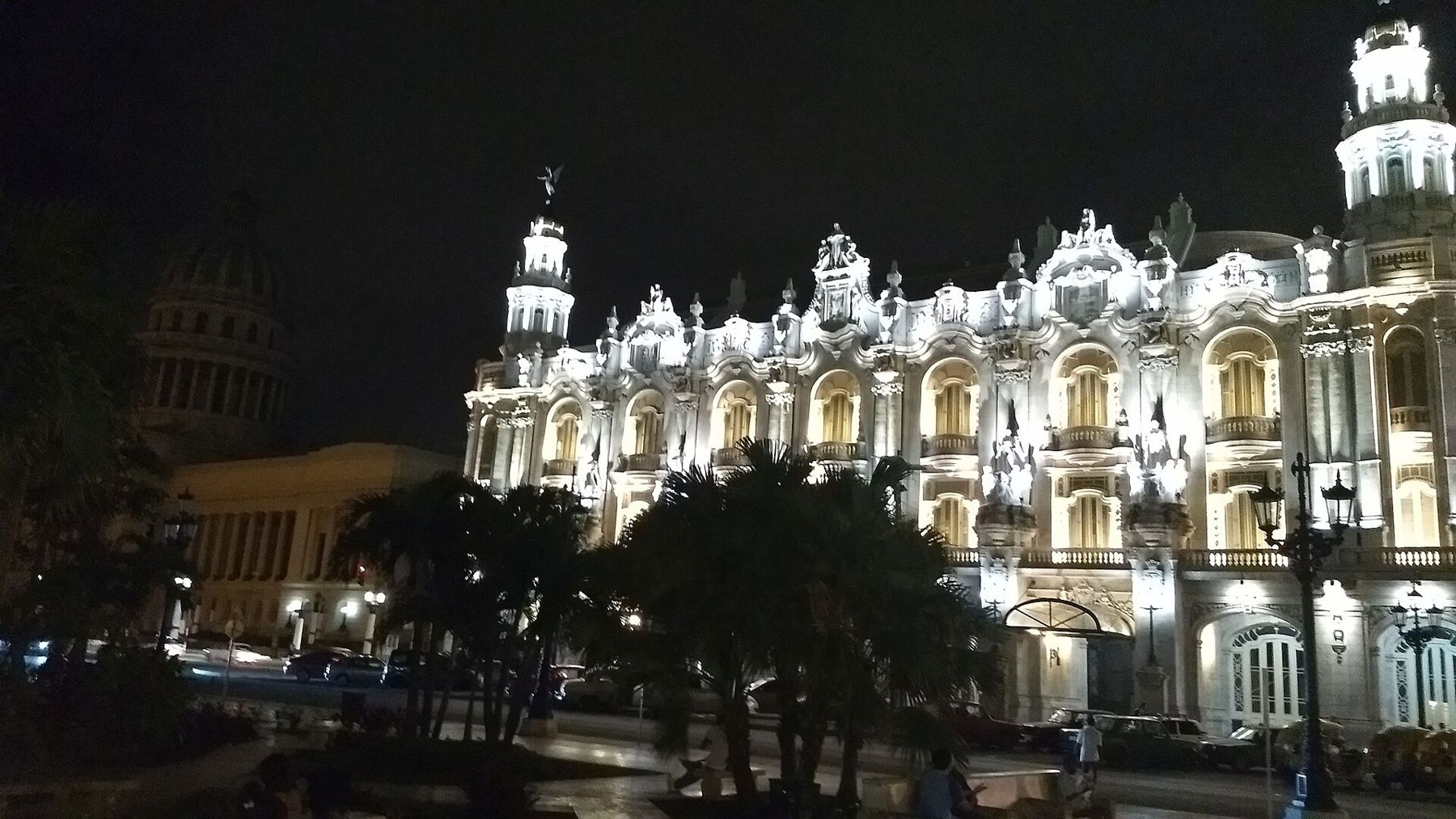
An evening plan
A good shape for the day: an afternoon around Parque Central and the Capitolio, an early dinner nearby, the performance, then a slow walk down the Prado to the sea. The Gran Teatro is easy to find: from almost anywhere in the old town or central Havana, ask for Parque Central, and the carved white towers will be standing over it.