Habana Vieja, the old walled city on the west side of the harbour, was laid out around a handful of open squares. Four of them sit within an easy loop of each other: Plaza de Armas, Plaza de la Catedral, Plaza de San Francisco de Asís and Plaza Vieja. On a map they look like four similar boxes. On foot, and especially by ear, they could hardly be more different. One is shaded and bookish, one is ringed by baroque stone, one opens onto the harbour, and one is a broad, bright room for the whole neighbourhood.
The old city and its fortifications were listed as a World Heritage Site in 1982, and much of what you walk through has been restored since then, building by building, a process that is still going on. That matters for the sound of the place. Some streets ring with scaffolding and hammers; others, finished years ago, are hushed in the morning and full of music by evening.
Plaza de Armas: shade, paper and wood
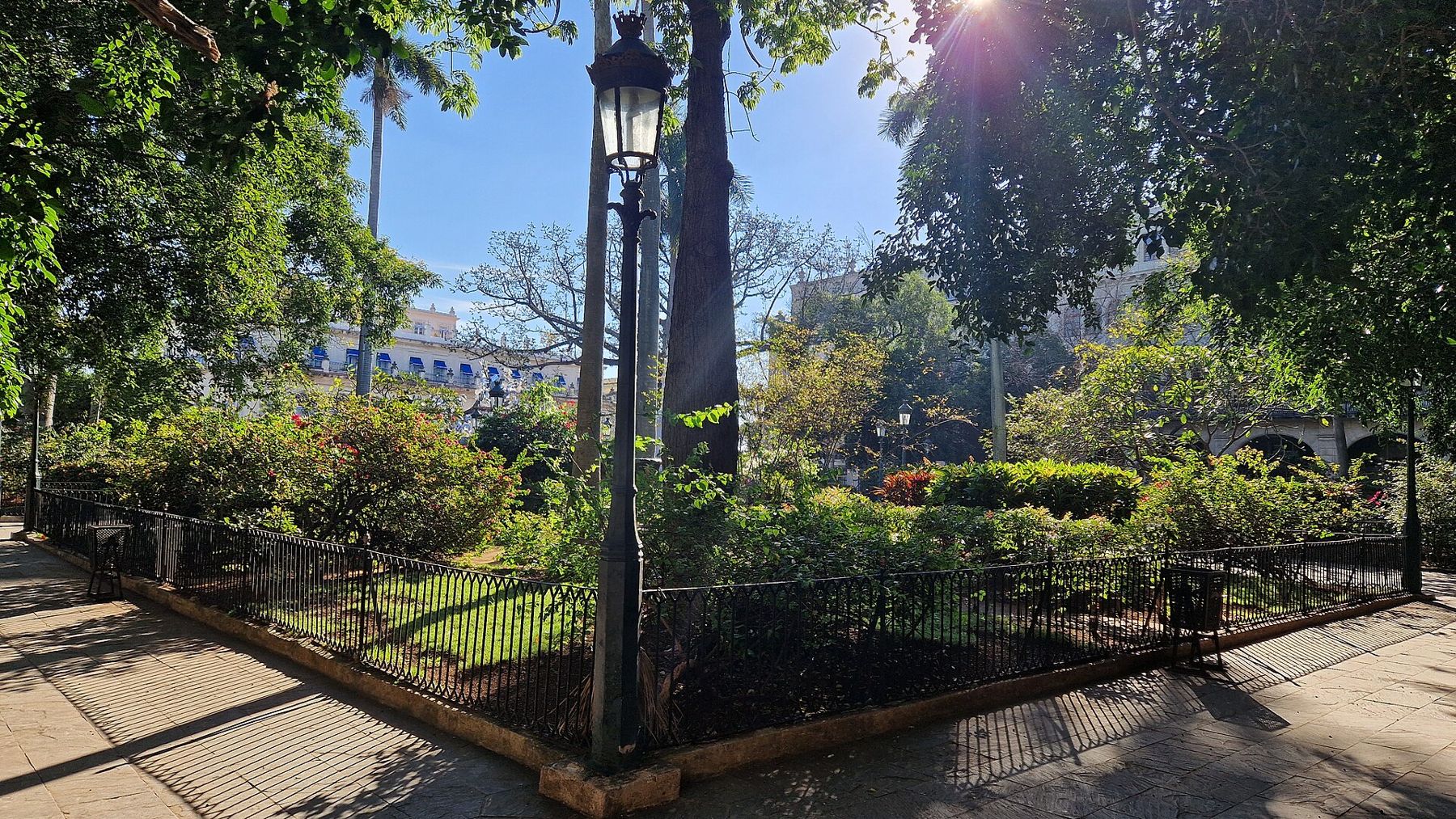
Plaza de Armas is the oldest of the four and the most green. Its centre is a small garden of royal palms, ceiba and flowering shrubs behind an iron railing, with benches in the shade. Around the edge, sellers of secondhand books, old magazines and prints set out their stalls on many days, and the dominant sound is a soft one: pages turning, prices murmured, a radio somewhere low.
On one side stands the former Palace of the Captains General, now the city museum, with its arcaded front and a courtyard of palms. The street in front of it is famous for being paved in wooden blocks rather than stone, a colonial measure meant to soften the clatter of carriage wheels outside the governor's windows. Stand on it for a minute and notice how the city noise goes slightly dull underfoot.
In a corner of the square, a small neoclassical temple called El Templete marks the place where the city is traditionally said to have been founded, beside a ceiba tree. Every November, on the city's anniversary, people queue to walk around the ceiba and make a quiet wish. Next to the plaza, the squat stone Castillo de la Real Fuerza, one of the oldest forts in the Americas, guards the harbour channel with a moat now mostly dry. From its walls you can see across the water toward the fortresses of the nine o'clock cannon ceremony.
Plaza de la Catedral: bells and baroque stone
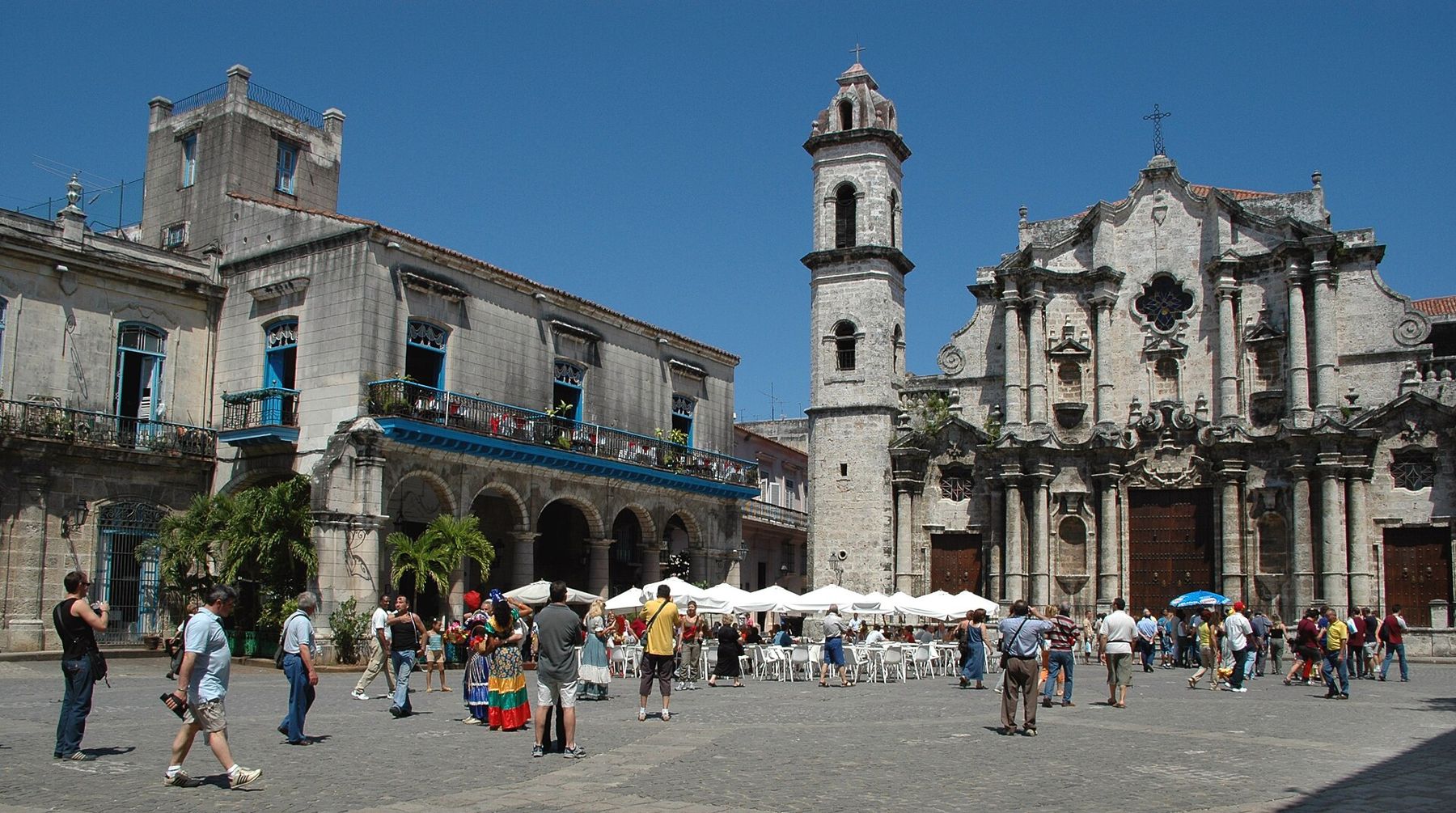
A few blocks north and west, the streets narrow and then open suddenly onto Plaza de la Catedral. It is a cobbled square, almost entirely enclosed by old stone mansions and the cathedral itself, whose eighteenth-century baroque front curves and ripples like a theatre curtain. Its two towers are not the same width, which you notice only once someone points it out and then cannot stop noticing.
Because the square is closed on most sides, sound stays inside it. Bells carry and echo. A single guitar on the cathedral steps fills the whole space. In the morning, when the café tables are still stacked and the cleaners are hosing down the stones, it is one of the quietest places in the old city. By late afternoon it is busy with walkers, and by dusk you may hear small groups playing son, the guitar-and-percussion music at the root of so much Cuban sound (the story of son explains its parts). Musicians who play for tips do so as a living; a coin or note in the hat is the usual courtesy if you stop to listen.
Because the square is closed on most sides, sound stays inside it.
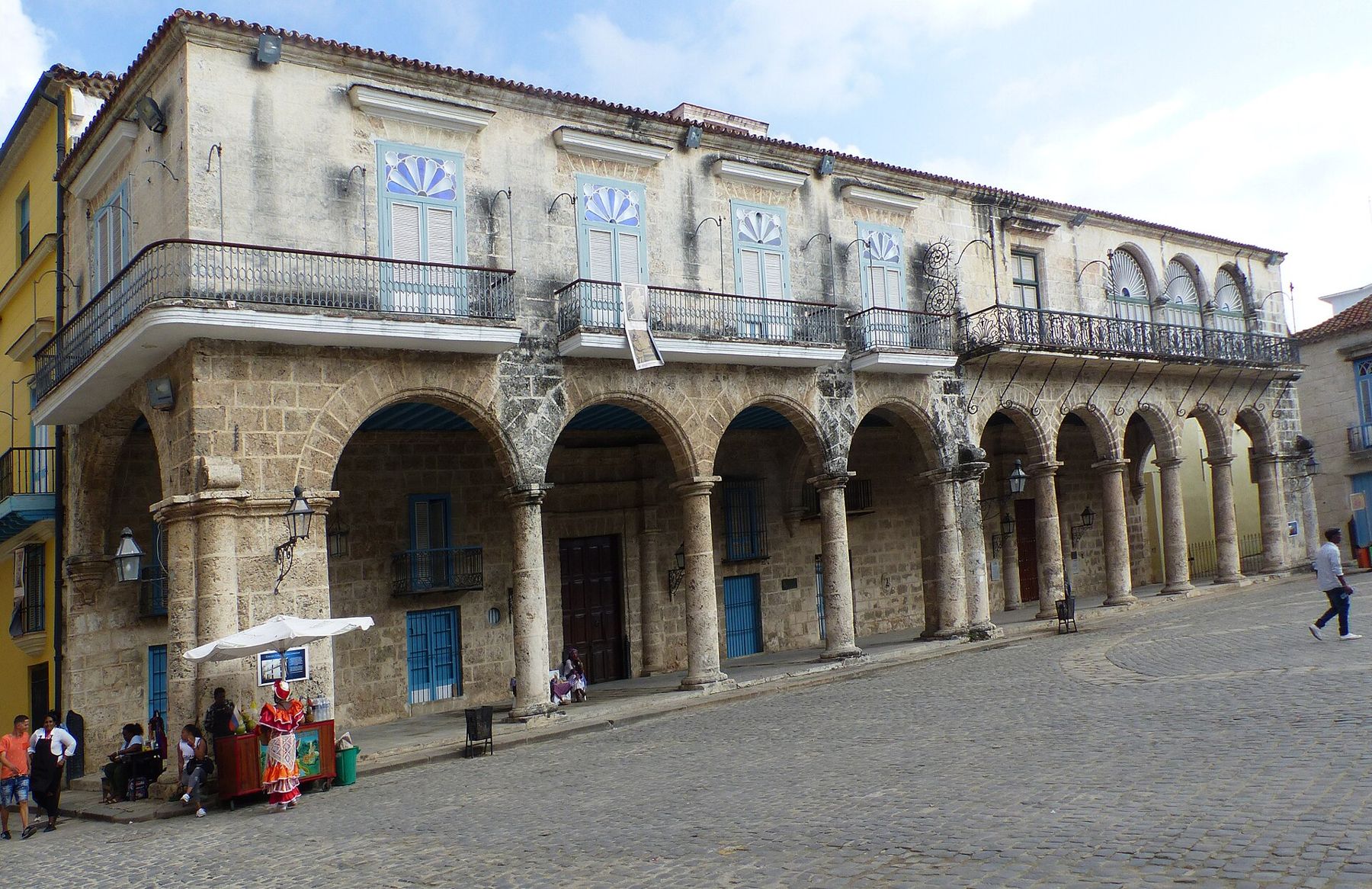
The houses around the plaza were once the homes of the colonial elite. One holds a museum of colonial furniture and decorative arts, and their deep arcades are good places to stand out of the midday sun.
 Flip it overThe Malecón at duskPhoto: PLBechly, CC BY-SA 4.0
Plaza de San Francisco: the harbour square
Walk south along the streets nearest the water and you reach Plaza de San Francisco de Asís, the plaza most open to the harbour. It is paved, wide and breezy, with a white marble lion fountain in the middle and the long stone front of the old Franciscan church and convent on one side. The church is no longer used for worship; its nave now hosts concerts of choral and chamber music, and the acoustics of high stone vaults are a good reason to check what is on.
The ambient sound here is all motion: the slap of the harbour against the quay, ship horns, pigeons wheeling up from the stones whenever a child runs at them, and the hum of the big terminal building across the road. From the waterfront nearby, the little ferries cross to Regla and Casablanca, a short trip that starts a few minutes' walk from this square and is covered in the harbour ferry story.
Plaza Vieja: the neighbourhood's living room
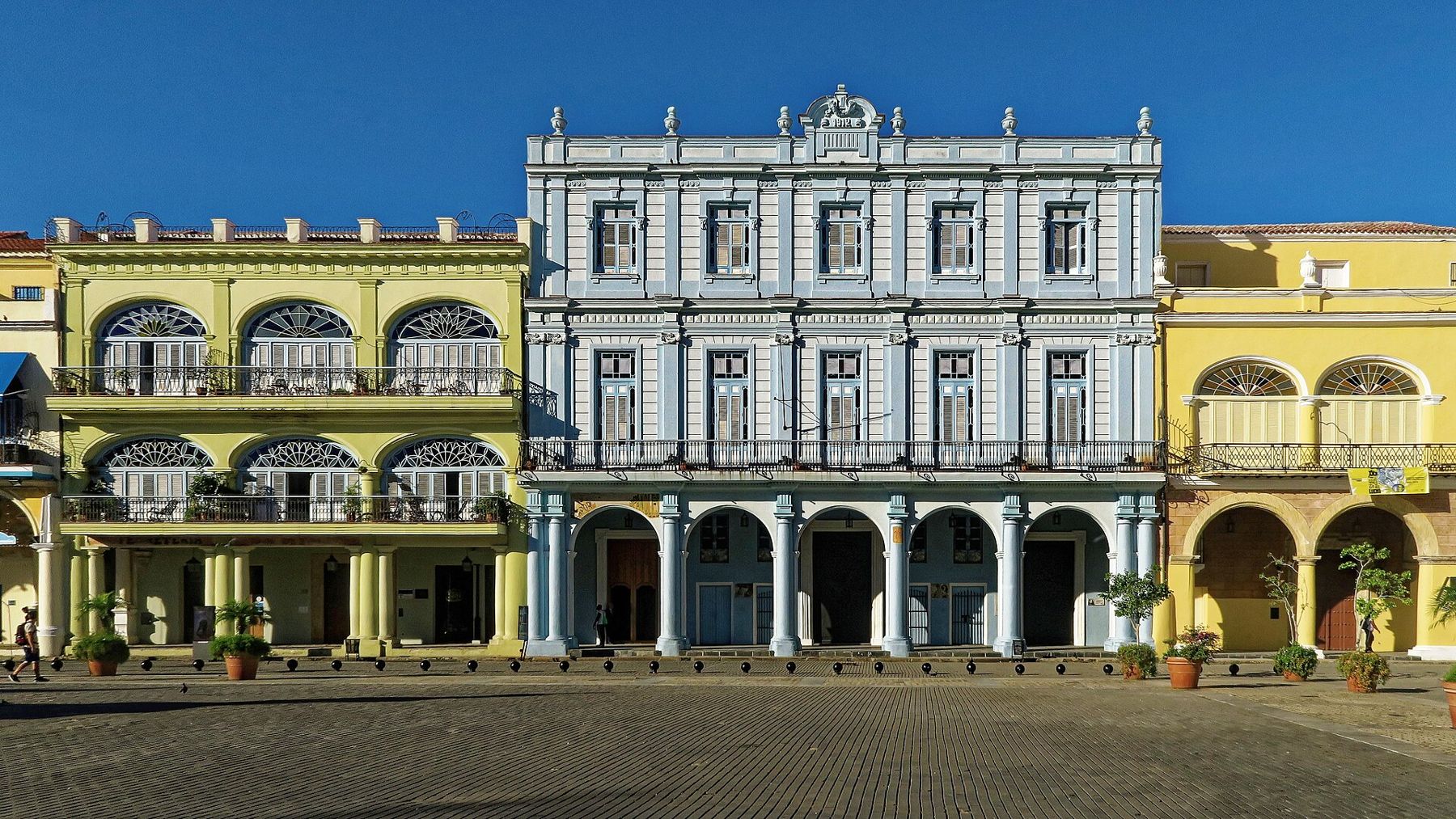
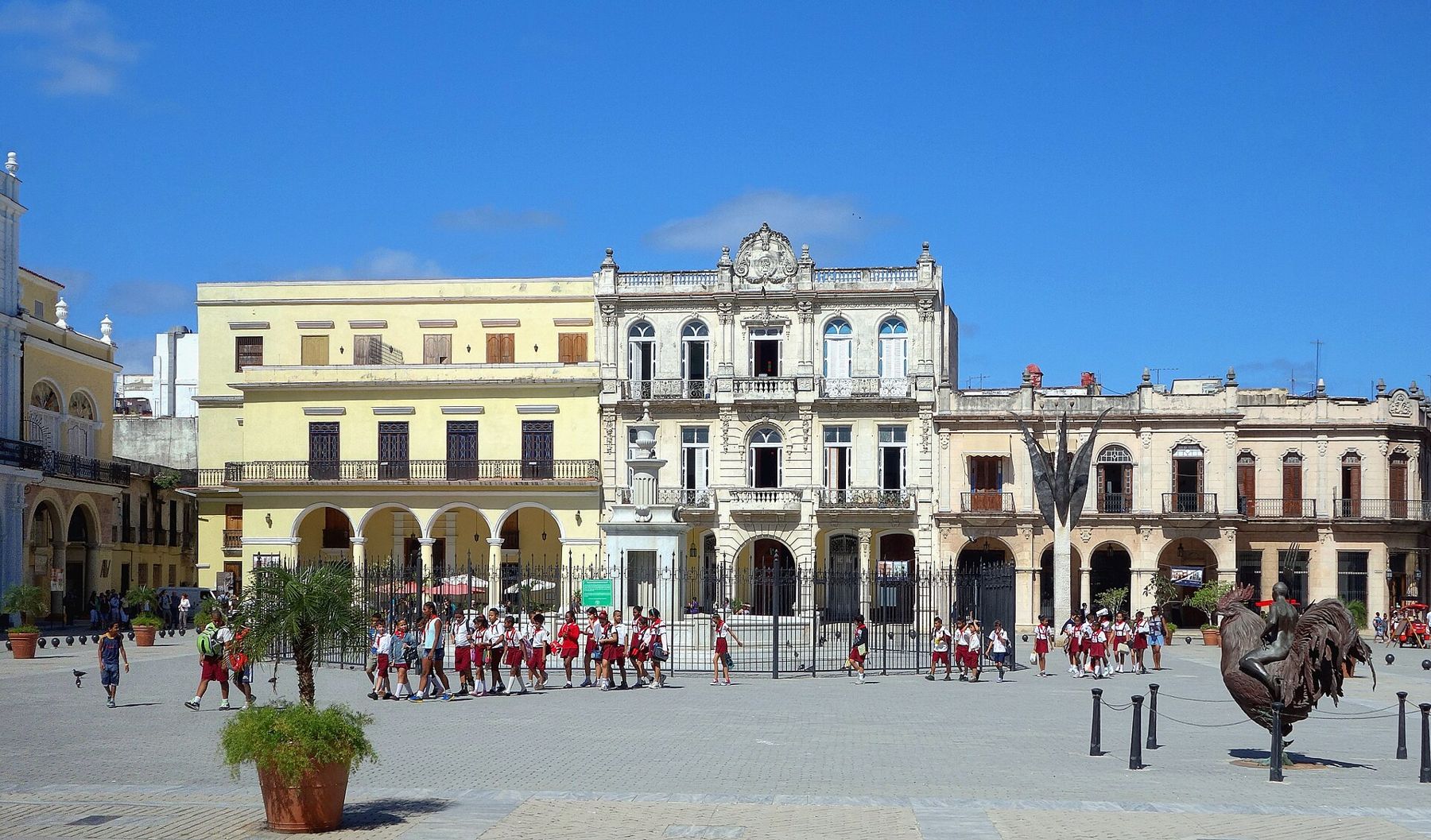
Plaza Vieja, the "old square", was in fact laid out later than Plaza de Armas, as a market square. For a long period it was neglected, and its eighteenth-century houses fell into poor repair. Since the 1990s it has been one of the showpieces of the restoration. Today its arcades, stained-glass fanlights and painted façades in ochre, blue and pale green frame a large open space with a fountain at the centre.
Because it is so open, Plaza Vieja carries every kind of sound at once. School groups cross it in the morning. Children kick balls against the fountain's base. In the afternoon, the arcades fill with conversation and the scrape of chairs, and as evening comes there is often live music drifting out from under the porticoes. One of the tall buildings on the square houses a camera obscura, a darkened room where a lens projects a moving live image of the surrounding rooftops onto a dish, an unusual way to see the old city from above.
The plaza also has a small sculpture of a woman riding a rooster with a fork in her hand, a strange and much-photographed modern piece that sets off a lot of puzzled discussion. You do not need to know its meaning to enjoy listening to people argue about it.
Walking the loop, hour by hour
The four plazas are close enough that you can walk between all of them in well under an hour without hurrying. A good way to understand them is to make the loop more than once, at different times of day:
- Early morning: start at Plaza de la Catedral while it is still quiet, then walk to Plaza de Armas as the bookstalls open.
- Midday: take shelter in the arcades of Plaza Vieja or the courtyard of the city museum. The open squares are hot and bright.
- Late afternoon: drift to Plaza de San Francisco for the harbour breeze and the light on the water.
- Dusk and after: come back to the Catedral and Plaza Vieja, when music is most likely and the stones give back the day's heat.
Opening hours for the museums, the church concert hall and the camera obscura vary and change, and some buildings close for restoration without much notice. Check before you go, and be ready to swap the order of the loop.
Listening well in the old city
A few habits help. Walk the side streets between the plazas, especially Obispo, Mercaderes and Oficios, rather than only the main squares; much of the sound of Habana Vieja is in its doorways, courtyards and balconies. Expect to be approached by people offering music, rides, cigars or directions. A polite "no, gracias" is enough. Carry small change if you plan to stop for street musicians, and ask before photographing anyone.
The old city is also a place where people live. Behind the restored façades are crowded homes, and the most honest sound of Habana Vieja is often a family radio, a parrot, a neighbour calling up to a balcony. If you want more of that lived-in density, the streets of Centro Habana begin just west of here.